


TIRANA BOOK FAIR 2025
CHALLENGES AND PERSPECTIVES OF ALBANIAN PUBLISHING IN THE DIGITAL AGE
By
From November 12 to 16, 2025, the Palace of Congresses in Tirana will host the “Tirana 2025” Book Fair, a seminal event organized by the Albanian Publishers Association that, for nearly three decades, has consolidated its importance as the principal forum for reflection on editorial, economic, and cultural developments in Albanian literature. Beyond its role as an exhibition, this fair serves as a laboratory for ideas and cultural policies, intertwining economic dimensions, social missions, and strategic visions for the future of the Albanian publishing industry in the context of regional and global transformations.
The Albanian publishing industry currently faces a complex array of structural challenges, including high printing costs, limited working capital, and a still-fragile distribution infrastructure. Even well-known authors often publish modest print runs of 30–50 copies due to financial barriers that limit book circulation. Bookstores, which in international models serve as essential educational and cultural hubs, are absent in over 70 percent of Albanian cities, often functioning more as offices than genuine cultural institutions. This structural gap renders the publishing sector a domain sustained more by passion than by sustainable economic policies.
At the regional level, challenges are equally evident. Albanian-language books published in Pristina, Skopje, Tetovo, or Ulcinj rarely reach the Tirana market, while publications from the capital have limited distribution abroad. The fragmentation of the Balkan market, lack of logistical cooperation, and high transportation costs hinder the creation of a unified Albanian book space. This lack of regional integration directly affects the circulation of ideas, the development of readership, and the international competitiveness of Albanian publishers.
Across the region and in Europe more broadly, book fairs have evolved into strategic platforms for publishing industry development and cultural diplomacy. In Frankfurt, London, Paris, Bologna, and Belgrade, state and municipal authorities financially support publishers’ participation, often subsidizing national pavilions and providing free spaces for small publishers and emerging authors. These fairs are not only exhibition centers but professional ecosystems where international agreements on copyright, translations, co-productions, and new distribution networks are established. Examples from Belgrade, Sofia, and Bologna demonstrate that structured public support and private-sector partnerships ensure sustainability, cultural impact, and long-term development of the publishing industry.
In this context, institutional support and public policies remain crucial for the survival and advancement of the Albanian publishing industry. Without sustainable funding mechanisms and legislation that encourages cultural and literary sponsorship, the sector risks losing its educational and cultural function. European models demonstrate that sponsorship laws, which enable private enterprises to support arts and culture, stimulate circulation, creativity, and broader reader access.
A concrete measure requiring immediate attention from the Albanian government is the removal of participation fees for publishers at national book fairs. At least once a year, the state should facilitate free participation for all market operators, from major publishers to small initiatives, independent bookstores, and digital platforms. The experience of the International Cultural Center, known as the Pyramid, which under my direction organized in 2007 a free book fair for all participants—self-financing approximately €70,000—demonstrated that such a model produces measurable results: increased numbers of publishers, reduced book prices, and extraordinary reader participation. Such a policy should not be viewed as a budgetary expense but as a strategic investment in national cultural capital.
In parallel, Albanian publishers can benefit significantly from European Union programs supporting the development of cultural and creative industries. Initiatives such as Creative Europe, the Digital Europe Programme, and the European Collaborative Cloud for Cultural Heritage offer funding for translation, publishing, international circulation, staff training, digitalization of editorial processes, and modernization of printing technologies. By participating in international consortia, Albanian publishers can raise professional standards, access international distribution networks, and advance toward digital transformation. Programs such as the Circulation of European Literary Works under Creative Europe support translation and promotion of European literature, while Digital Europe projects aim to enhance digital capacities in the cultural sector. These represent concrete opportunities to modernize the Albanian book industry and integrate it into the continent’s cultural ecosystem.
Another critical dimension concerns global transformations in book production and consumption. Worldwide, print books face continuous competition from digital formats, including e-books and audiobooks, which have profoundly changed how readers interact with texts. This requires Albanian publishers to develop multiformat strategies that preserve the tradition of print while integrating contemporary technologies. For the Albanian market in the Balkans, with still-limited financial and infrastructural capacities, this challenge can become an opportunity if supported by institutional policies that encourage innovation and sustainable access across all formats.
Equally important is engaging younger generations in a culture of reading. In an age of fragmented attention due to digital media, it is essential that educational programs, libraries, and publishers collaborate in creative initiatives: reading programs in schools and universities, book clubs, interactive events, gamification of reading experiences, and promotion of books through social media. These strategies aim to create a new cultural balance between print reading and digital consumption, preserving the cultural and aesthetic identity of the book.
If governmental intervention and support are lacking, the Albanian print book industry risks a progressive contraction within the next decade. Without subsidies, favorable fiscal policies, and investments in distribution and technology, many small publishers will disappear, print runs will decline significantly, and print books will remain an elite product, largely inaccessible to the wider public.
In 10 to 20 years, in the absence of public intervention, the market will be dominated by digital formats and international platforms, while Albanian print books will exist primarily as symbolic or collector’s items rather than as living instruments of cultural communication. Only an active and sustainable cultural policy can protect print books as a vital part of national identity and collective memory.
In this sense, the Tirana Book Fair 2025 is far more than an annual exhibition; it is a national space for reflection, a platform for professional and civic dialogue on the emancipatory mission of the book. Participation in this fair is not merely a commercial act but a civic and cultural investment in the future of Albanian society, in strengthening cultural awareness, and in revitalizing reading as an act of freedom and independent thought.
In conclusion, we wish every success to the Tirana Book Fair 2025, its organizers, publishers, authors, and readers, inviting the wider public to actively engage in this process by visiting even the National Publications Pavilion, part of this fair. Let us view the book not merely as a market commodity but as a source of cultural energy that shapes thought, fosters citizenship, and reinforces our European identity.
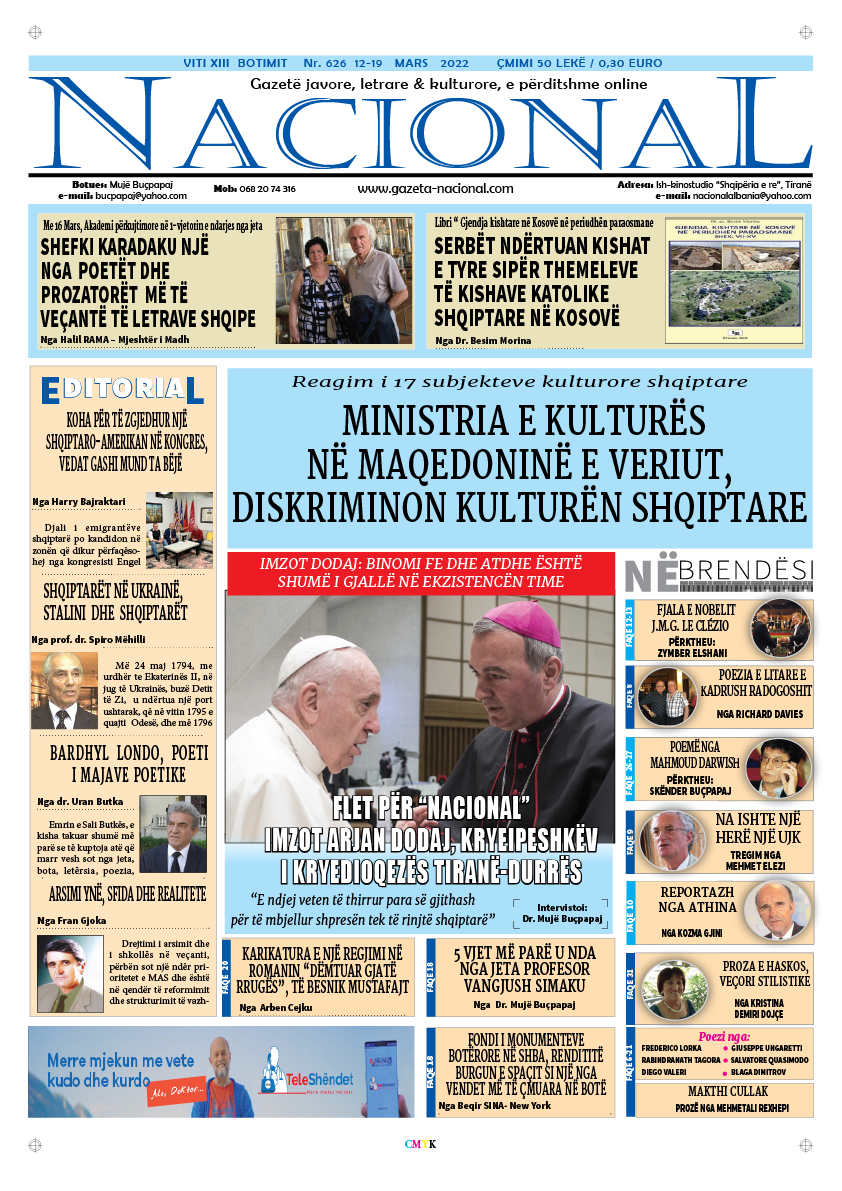
The author is the founder and publisher of the literary and cultural newspaper “Nacional,” director of Botimet Nacional, an internationally recognized poet, literature scholar, and promoter of Albanian literature internationally.