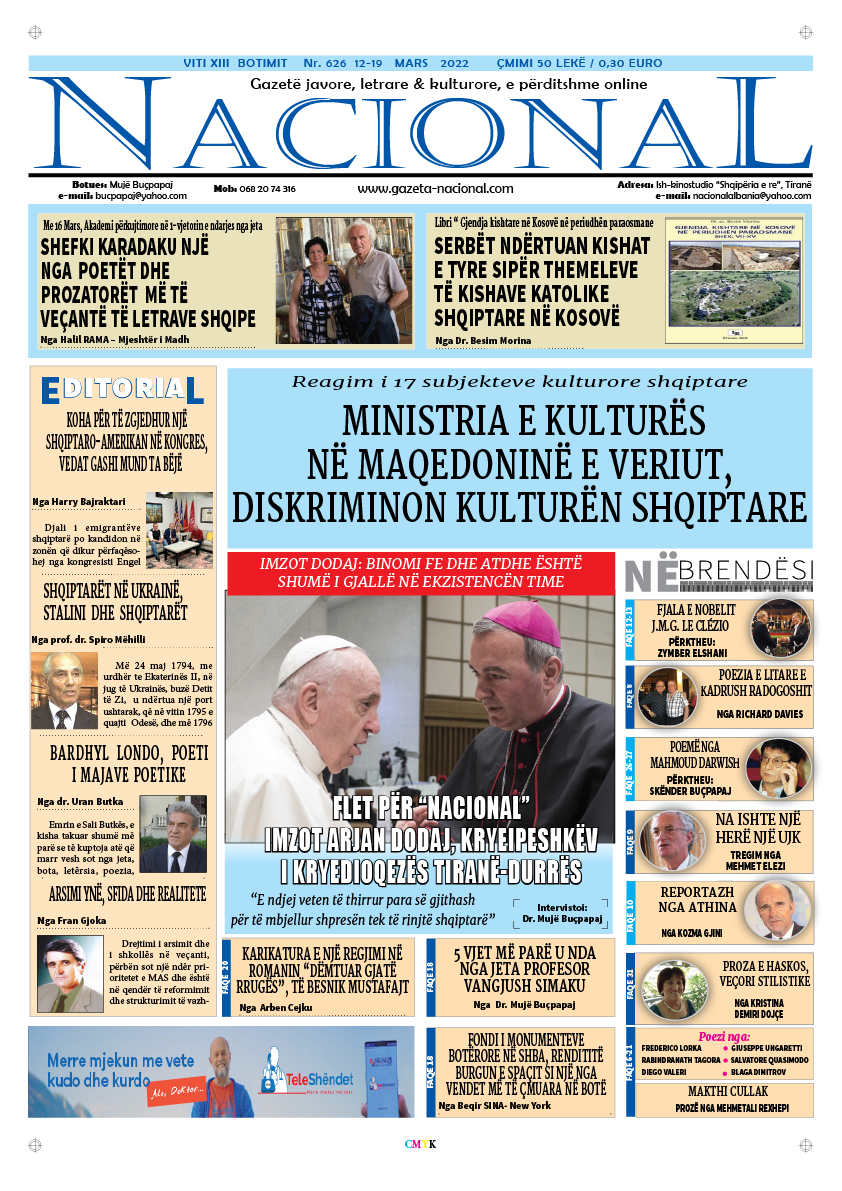



“Grotesque as a Moral Testimony of a Traumatized Communist Era”**
Tetova, September 25, 2025 – In the academic amphitheater of the University of Tetova, where voices of knowledge and critical thought converge to reflect on Albanian cultural heritage and literary interculturality, the 19th International Seminar of Albanology was inaugurated, bearing the central theme:
“Cultural Dialogue between Albanian and World Literature.”
Among the most distinguished voices that resonated strongly in this scholarly forum was that of the researcher of modern and post-communist literature, Dr. Mujë Buçpapaj from Tirana. He delivered a profound and well-articulated analysis on a theme that continues to challenge the collective Albanian consciousness and contemporary aesthetic discourse.
In his presentation titled
“The Portrayal of a Grotesque Reality and a Traumatized Communist Society in Contemporary Novels,”
Dr. Buçpapaj offered a complex perspective on how grotesque elements, irony, and documentary realism are employed to construct narratives that confront historical silence and reveal the unhealed wounds of a repressive era.
At the center of his study stood the novel The Second Devil by Qazim Shehu, which, according to the scholar, transcends its literary form to become an indictment and an ethical document against forgetfulness. Applying a text-analytical and comparative methodology, Dr. Buçpapaj placed Shehu’s novel in dialogue with works by other Albanian and foreign authors—such as Ismail Kadare, Fatos Kongoli, Flamur Buçpapaj, Bashkim Shehu, Bashkim Hoxha, and the German-Romanian Nobel laureate Herta Müller—to construct a polyphonic map of the experience and representation of dictatorship.
At the heart of his analysis, Dr. Buçpapaj explored how grotesque aesthetics and the ironic rendering of absurd realities become both artistic and ethical tools for narrating, through the metaphor of the Albanian gulag, an existential experience that surpasses the political and enters the realm of human tragedy.
Characters such as Arsen Lipa, a silent survivor of systemic injustice, and Idrizi, a moral figure and symbol of quiet resistance, were examined as metaphors for individuals who preserve their dignity in a world shattered by fear, blackmail, and ideological hypocrisy.
In a detailed comparison with Herta Müller’s The Land of Green Plums, the scholar focused on the stylistic nuances and narrative approaches that distinguish—but also unite—the experiences of Eastern European dictatorships. Shehu, according to Buçpapaj, constructs a simple yet emotionally charged narrative, imbued with bitter realism and an uncompromising ethical stance toward the past.
In concluding his lecture, Dr. Mujë Buçpapaj emphasized that post-communist Albanian literature, with novels such as The Second Devil, carries the weight of collective memory—a past not archived, but continuously returned to, in order to be understood, questioned, and transformed into a more enlightened historical and civic consciousness.
His contribution was met with particular interest by the audience, sparking vibrant debate and deep reflection on the role of literature as a medium of truth.
In an era where narratives of dictatorship are often replaced by silence or fabricated nostalgia, Dr. Buçpapaj’s voice stands out as a clear and unwavering call for truth through the art of the written word.